How to Repair a Broken Sprinkler Pipe (and When to Call a Pro)

Thousand Oaks & the Conejo Valley — A Straight Answer Before You Start Digging

A broken sprinkler pipe is often a fast, cheap fix if it’s a clean break in an accessible spot. This guide walks through how to find it, how to fix a straightforward PVC break yourself, and when the situation is bigger than a DIY repair. Evergreen Sprinklers has repaired irrigation and outdoor water lines across the Conejo Valley since 1972, licensed under CSLB #949420 (C36 – Plumbing), if you’d rather skip straight to calling.

Signs you have a broken pipe

A few things usually give it away: a sprinkler zone bubbling from the ground instead of the heads, a soggy or sunken patch of lawn that shows up even when the system isn’t running, a sudden drop in pressure across a zone, or a spike on your water bill with no obvious cause. Sometimes it’s more dramatic, a visible geyser or puddle the moment a zone kicks on. Any of these is worth investigating before it gets worse; a small crack under pressure rarely stays small for long.

Soggy ground over a leaking sprinkler line before excavation - Thousand Oaks
A patch of ground that stays wet even when the system is off — what a hidden leak often looks like from above.

How to find the break

Run the affected zone and look for the obvious signs first: bubbling water at the surface, a wet patch that appears only when that zone is on, or a visible seepage from below ground. If nothing’s obvious above ground, check along the pipe run between the valve and the nearest heads, since that’s usually where breaks happen, at fittings, near tree roots, or anywhere the pipe was nicked during other yard work. Once you’ve narrowed it down to a general area, dig carefully with a hand trowel rather than a shovel until you can see the pipe and confirm exactly where the crack or break is.

Cracked sprinkler pipe exposed during excavation - Evergreen Sprinklers
Once you dig, this is what you’re looking for — a crack hiding under a few inches of soil and roots.

DIY fix for a clean PVC break

If it’s a single clean break in accessible PVC pipe, away from a valve manifold and away from the main line, it’s often a repair a handy homeowner can do. First, shut off water to the zone. Dig out enough soil around the break to work comfortably, at least six inches on either side of the damage. Using a hacksaw or PVC cutter, cut out the damaged section cleanly on both sides, leaving square, even edges. Dry-fit a coupling, or a slip-fix repair coupling if you don’t have enough pipe movement to slide a standard coupling into place, to confirm it spans the gap correctly. Once it fits, apply PVC glue to both the pipe ends and the inside of the coupling, following the product’s instructions, and push the fitting fully into place with a quarter turn to spread the glue evenly. Hold it for the few seconds the glue needs to set, then leave it undisturbed. Let the joint cure for a couple of hours before pressurizing or backfilling — for 1-1/2-inch pipe or larger, give it a full 24 hours. Turn the zone on slowly and check the joint for drips before you walk away.

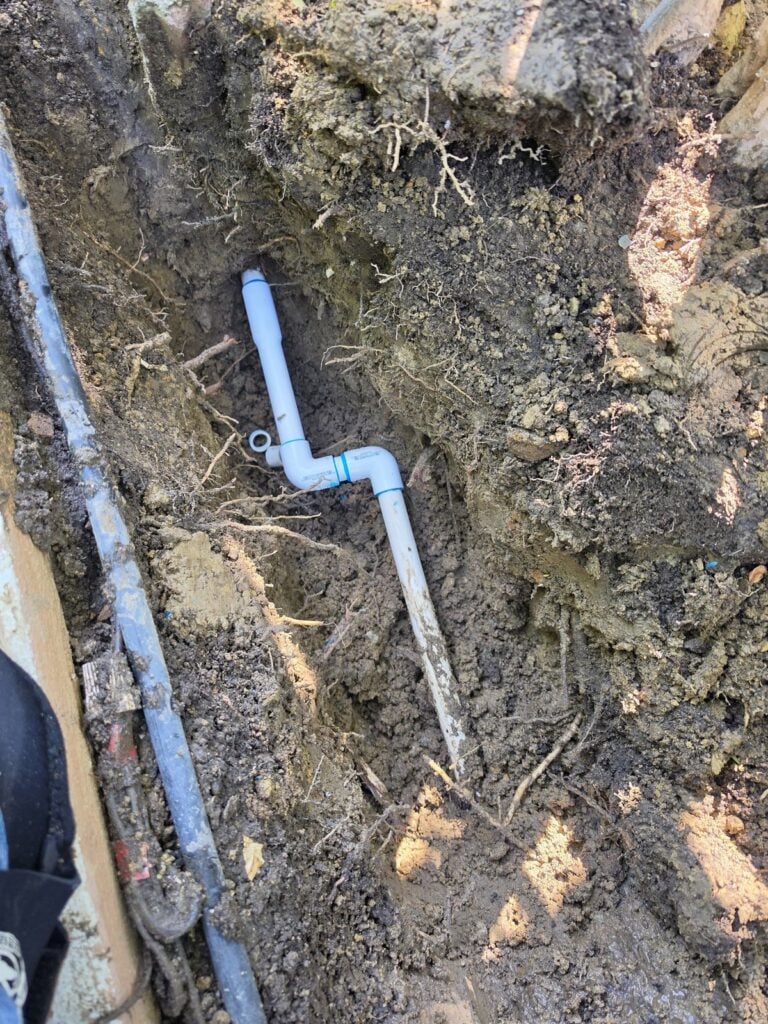
Broken pipe repair in root-entrenched ground - Evergreen Sprinklers
A finished repair with new fittings glued in — rerouted cleanly where the old line failed.

When DIY goes wrong (and when to call a pro)

A few situations are worth calling a professional for instead of digging in yourself. Tree roots wrapped around or growing into the pipe can often mean the break will recur nearby even after a clean repair, and it needs a broader fix, not just a patch. Anything at or near the valve manifold is more involved than a straight pipe repair, since you’re working around multiple zones and wiring in a small space. A break on a line running at full water-main pressure, rather than at the reduced pressure inside an irrigation zone, needs a repair rated and installed for that pressure, this crosses into work covered by our CSLB C36 license rather than a standard irrigation fix. And if you’ve already made one repair and the same area breaks again, or a new leak shows up nearby, that’s usually a sign of a bigger problem, shifting soil, a compromised section of pipe, or root intrusion, that a patch will only repair temporarily. When any of that applies, it’s a smaller job to call a licensed crew before you dig further than to fix a mistake after the fact.

Sprinkler pipe repair rerouted around tree roots - Evergreen Sprinklers
Tree roots forced this line into a tight reroute — the kind of break that usually comes back if you just patch it.

Not sure if it's a sprinkler line or something bigger?

If the leak turns out to be on your water main or service line rather than the sprinkler system, that’s licensed plumbing work under our C36 classification, not a DIY irrigation fix. See our water leak repair page for the signs that point to a water main issue instead of a sprinkler line, and how we locate and repair it either way.

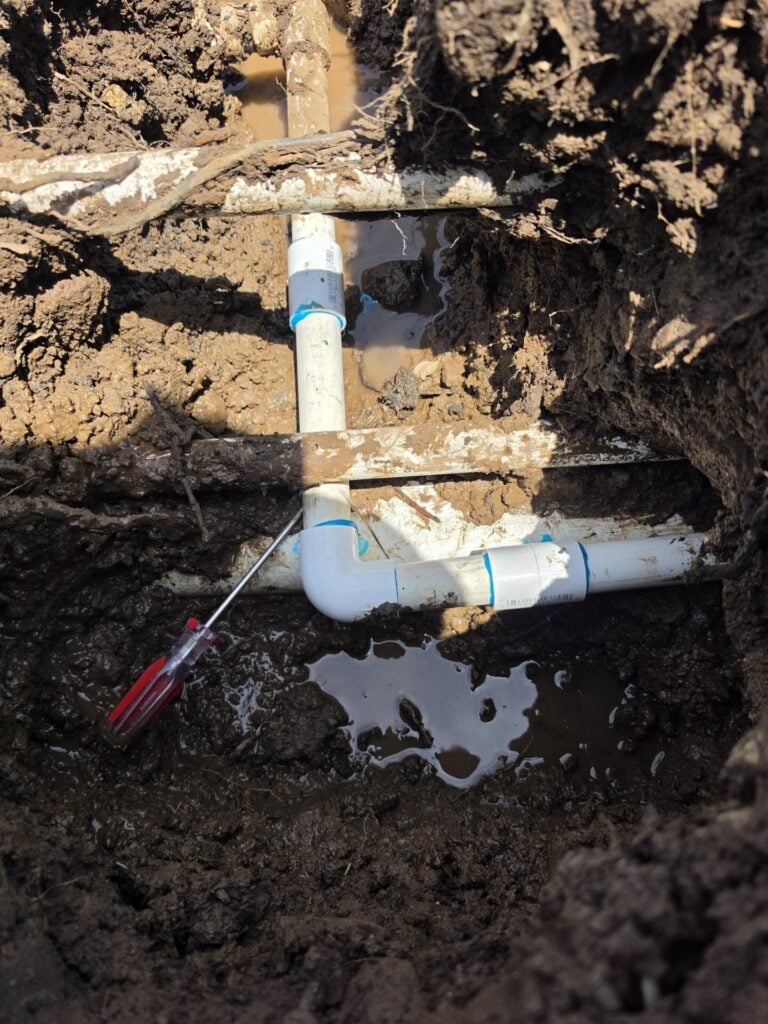
Broken pipe repair in root-entrenched ground - Evergreen Sprinklers
Standing water in the trench means the leak had been running a while — the sooner it’s isolated, the less it costs.

Broken pipe bigger than a quick fix?

Evergreen Sprinklers repairs broken sprinkler pipes and outdoor water lines throughout Thousand Oaks, Westlake Village, Newbury Park, Agoura Hills, Malibu, Santa Rosa Valley, Lake Sherwood, Camarillo, Moorpark, Oak Park, North Ranch, Dos Vientos, Wood Ranch, and Ventura. Free on-site estimates; our trip charge is $100 for the first hour, plus parts. Call (805) 390-7437 and we’ll take it from here.