
A failed valve is the difference between a zone that waters and a zone that floods. Since 1972, Evergreen Sprinklers has repaired and replaced irrigation valves across Thousand Oaks and the Conejo Valley — and we set the manifold up so the next repair is a quick swap instead of another excavation.
Most valves that stop working have not really broken — a single part inside them has. The rubber diaphragm that seals the valve shut hardens, tears, or traps a piece of grit and stops seating, which is what leaves a zone weeping long after the controller shut it off. The solenoid, the small electrical coil on top, burns out or loses continuity and the zone simply never opens. Wiring is the third culprit and the one most often misread: a corroded splice or a nicked common wire will imitate a dead valve exactly. We trace the wiring and test the solenoid before condemning anything, because replacing a healthy valve on a bad wire fixes nothing. That electrical fault-finding is the same valve tracing work we list on our services page, and it is usually what separates a short repair from a long one.
A valve replaced the ordinary way is glued straight into the line. That works, and it means the next person to service it — often us, years later — has to excavate the valve bank again and cut the pipe again. So when we rebuild a manifold we set schedule 80 unions above and below each valve. A union is a threaded collar that lets the valve be unthreaded and lifted out by hand. The first repair costs a little more in fittings; every repair after it costs dramatically less in labor, because nobody is digging out and re-cutting a glued manifold to change a part that is designed to wear out. Schedule 80 is the heavier-walled grey PVC, chosen here because unions take repeated wrenching that thin-wall fittings do not survive.
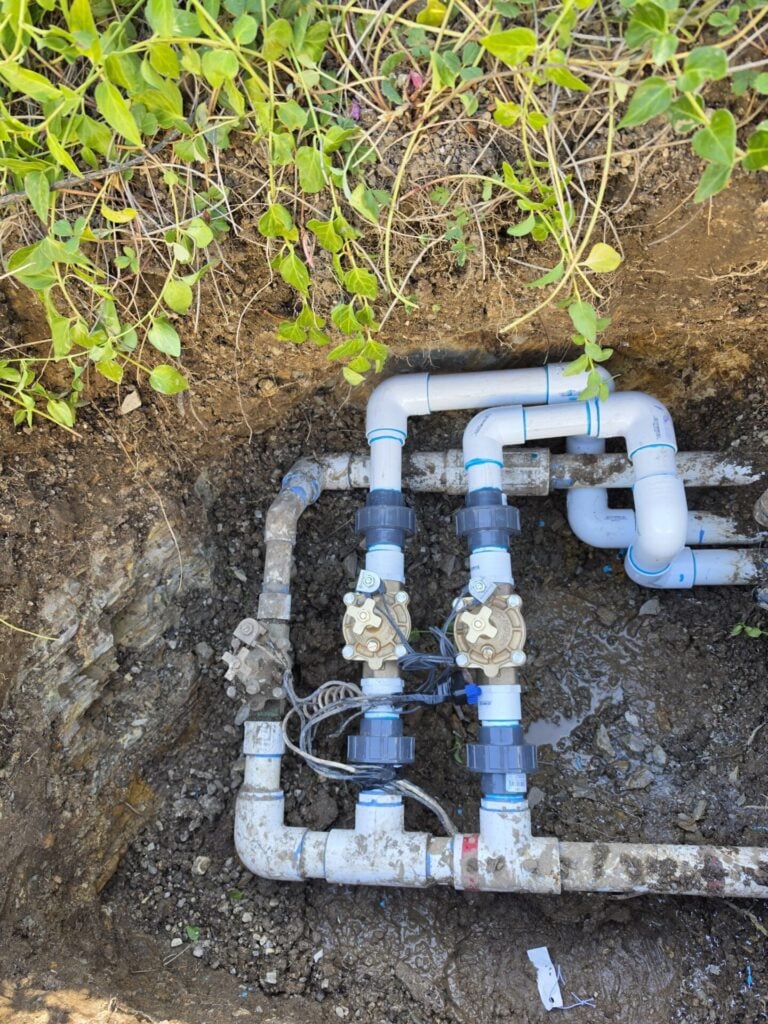
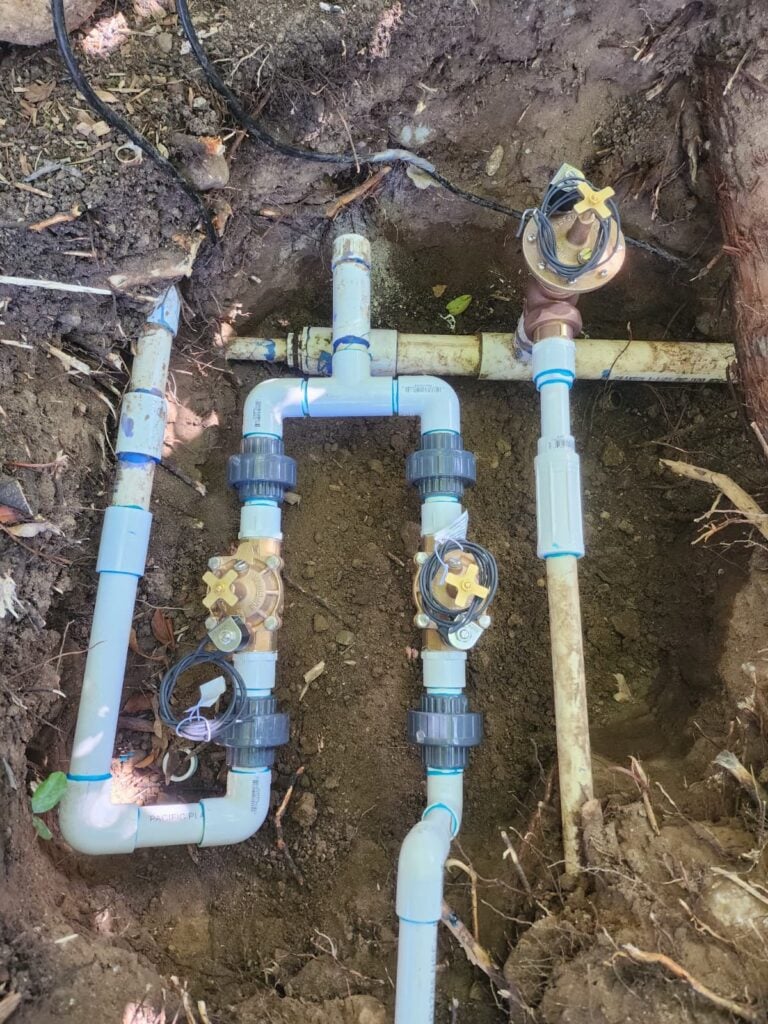
You will find plenty of guides showing how to change a diaphragm with the valve body left in the ground, and it is a real repair — it is just not a reliable one. In our experience it remedies the problem about half the time. The other half, the valve is back within months, because the diaphragm was the part that gave out first rather than the only part that was worn. So we replace the valve instead of rebuilding it, and we set unions above and below the new one. You pay for the valve once rather than paying twice for the same diagnosis — and if that valve ever does fail, swapping it is a wrench job rather than another excavation.
Some do, but irrigation valves sit in a different trade from the plumbing inside your house. They live outdoors, downstream of a backflow device, on low-pressure lateral lines controlled by low-voltage wiring — so the job is part pipe work and part electrical. Evergreen Sprinklers is licensed, bonded, and insured under CSLB #949420, a C36 plumbing classification, and outdoor irrigation and water lines are the work we do every day rather than a sideline. That matters most where the two trades meet: at the backflow assembly, on the mainline running to the valve manifold, and on any zone where a valve fault and an underground water leak look identical from above ground.
These two complaints point at opposite ends of the same valve. A zone that keeps running after the controller shuts down is almost always a diaphragm that cannot seat — grit under the seal, a torn membrane, or a manual bleed screw left cracked open — and it will keep passing water until the valve is opened up. That specific symptom has its own walkthrough on our sprinklers that will not turn off page. A zone that never starts is usually electrical instead: a failed solenoid, a broken common wire, or a controller output that is no longer sending voltage. Both are worth reporting accurately when you call, because a zone stuck on is wasting water every hour it waits.
Three things, in order. First, access: a valve in an accessible box is a short job, while one buried under a rebuilt patio, ivy, or years of raised grade has to be found and uncovered first. Second, whether the valve already has unions on it, because a manifold that was rebuilt properly the last time is far quicker to work on than one glued solid. Third, what the rest of the manifold looks like, since valves sharing a bank of brittle old pipe are often better rebuilt together than one at a time. Estimates are done on site at no charge: we open the box, tell you which of those three you are actually dealing with, and put the scope in writing before any work starts.
Evergreen Sprinklers has been the trusted, family-run name in irrigation repair across Thousand Oaks and the Conejo Valley since 1972 — licensed, bonded, and insured under CSLB #949420. We open the valve box, show you what failed, and put a written scope in your hands before any work starts.
We repair and replace irrigation valves throughout Thousand Oaks and the wider Conejo Valley — the same crew that traces the fault is the crew that rebuilds the manifold.
Camarillo – Santa Rosa Valley – Ventura – Malibu – Thousand Oaks – Newbury Park – Dos Vientos – North Ranch – Westlake Village – Agoura Hills – Oak Park – Moorpark – Wood Ranch – select areas of Calabasas & West Hills — plus Lake Sherwood and all of the Conejo Valley
We repair and replace irrigation valves throughout Thousand Oaks, Newbury Park, Westlake Village, Agoura Hills, Oak Park, Moorpark, Camarillo, Malibu, and across the Conejo Valley. Call (805) 390-7437 — tell us whether the zone is stuck on or will not start, and we’ll come open the box at no charge.