
A new lawn is only as good as the water it gets. Evergreen Sprinklers has installed and repaired irrigation systems across the Conejo Valley since 1972, and we check your sprinkler coverage before a single pallet of sod goes down, licensed under CSLB #949420 (C36 – Plumbing).
Successful sod installations start with the preparation, not with the grass. We prep the soil first, clearing old growth and debris, tilling or amending as needed, and grading the area so water drains the way it should instead of pooling in one spot or running off before it soaks in. Then we check the irrigation coverage for the area: are the existing heads spaced and positioned to reach the whole new lawn, is pressure even across the zone, is anything missing or damaged. This is where being an irrigation company first shows up in the result. A landscaping crew that only handles the sod itself can lay a perfect lawn over a sprinkler system with dry spots or overlap gaps, and the lawn shows it within a few weeks. We handle both, soil prep and grading plus the irrigation check, or the repair or adjustment if coverage needs work, so the new lawn has what it needs to establish evenly from day one.
Sod comes by the pallet here, and the amount you need depends on the square footage of the area you’re covering. Measure the length and width of the space in feet, multiply for square footage, and add extra for any cuts around curves, trees, or edging. Use the calculator below for a rough estimate; we’ll confirm the exact quantity and give you a firm quote during a free on-site estimate.
Enter your lawn area to see roughly how much sod to order. This is a planning estimate, not a quote.
Assumes ~10 sq ft per roll and ~450 sq ft per pallet, standard industry sizing that can vary by supplier. Order 5–10% extra to cover cuts around curves, trees, and edging. This estimator does not calculate price — call for a free on-site estimate with an exact quote.
Get an exact quote free — (805) 390-7437Sometimes a lawn is in poor enough shape that replacement makes more sense than trying to nurse it back. Before we recommend a full replacement, though, we look at why the lawn failed in the first place. Often it’s the sprinklers; sometimes it’s the grass. A lawn with uneven coverage, a broken head, or a failed valve can look identical to one that’s simply dying of age or disease, dry patches, brown edges, thin spots that never fill in, and replacing the sod without fixing the underlying irrigation issue just means the new lawn fails the same way the old one did. We diagnose both before recommending a path: repair the irrigation and see if the existing lawn recovers, or replace the sod once coverage is confirmed to be even across the area.
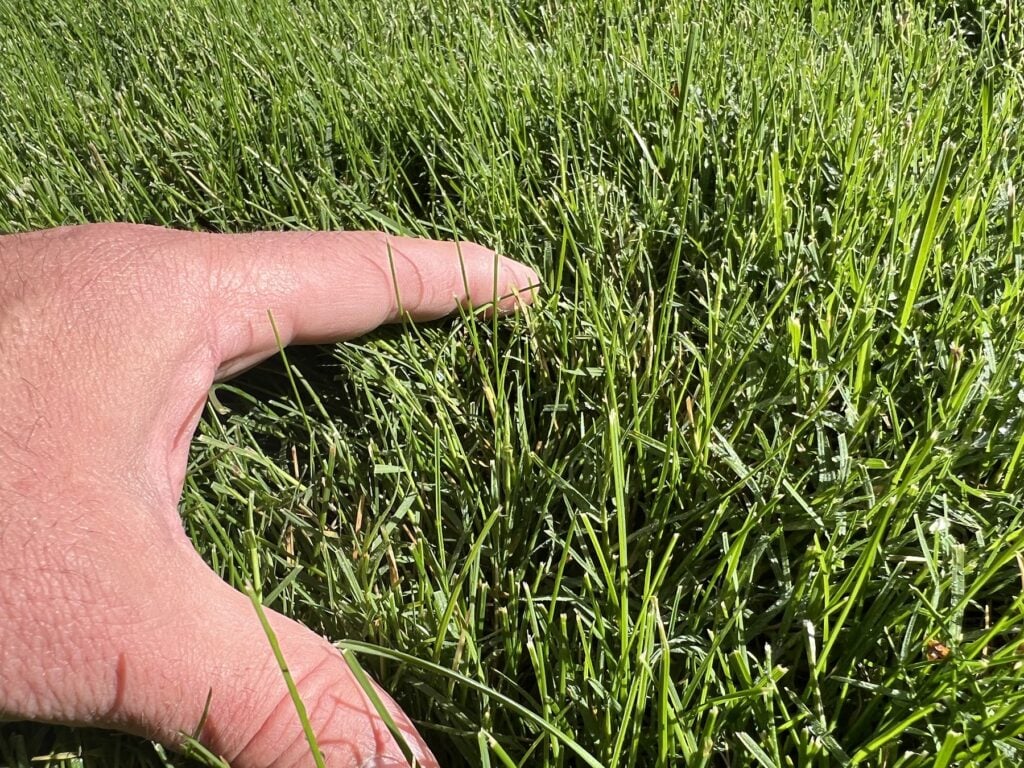
Marathon 1 tall fescue goes down on nearly every lawn we install. Tall fescue is a cool-season grass — it stays green year-round in the Conejo Valley, which is why most homeowners choose it, but it does ask for more water than the warm-season varieties. Warm-season grasses like hybrid Bermuda and St. Augustine use noticeably less water and shrug off summer heat; the trade-off is that during cold winters they may go dormant and turn brown until the weather warms (often not much of an issue in our area — dormancy here may only last about a month). We’ll talk through the right fit for your yard — sun, slope, water budget, and how the space gets used — during the estimate rather than defaulting to one option for every property.
Every new lawn we install gets Bio/Organics Endomycorrhizal Inoculant, applied the way the manufacturer directs it: as a drench over the sod once it is down, watered in right away so the spores carry into the root zone. Mycorrhizae are beneficial soil fungi that attach to grass roots and effectively extend them, reaching farther into the soil for water and nutrients than the roots can on their own. Established, undisturbed ground usually has them already; soil that has been graded, tilled, stripped of an old lawn, or compacted under construction usually doesn’t, which is part of why new sod can look hungry and thirsty even on a sensible watering schedule.
The payoff is better nutrient and moisture uptake: the lawn holds its color on less water and less fertilizer, and roots establish faster through the first few weeks, which is the window where new sod is most likely to fail. It’s a one-time application — the fungi colonize the roots and spread on their own as the lawn fills in, so there’s nothing to reapply and nothing added to your maintenance schedule. We apply it at the manufacturer’s turf rate of a pound per 2,000 square feet, so a 1.5 lb jar covers roughly 3,000 square feet of new lawn.
One thing to know afterward: these are living organisms, and the wrong products kill them. The manufacturer’s directions are to use only lower-analysis, gradual-release fertilizers — preferably organic — and to avoid soil-drench and systemic fungicides; fast-acting, high-phosphorus feeds are the ones that do the damage. With uptake already improved, the lawn generally needs less feeding than an uninoculated one would. We’ll go over the specifics with you when we hand the lawn off.
Evergreen Sprinklers is an irrigation company first, family-owned and serving the Conejo Valley since 1972, licensed under CSLB #949420, Classification C36. That order matters for sod: a new lawn’s biggest failure point isn’t usually the grass itself, it’s uneven watering. Because we install and repair sprinkler systems every day, checking coverage before sod goes down, and fixing it if it’s off, is standard practice for us rather than an extra step a landscaping-only crew might skip. One crew handles the soil, the irrigation, and the sod, so that all the bases are covered!
Evergreen Sprinklers installs and replaces sod throughout Thousand Oaks, Westlake Village, Newbury Park, Agoura Hills, Malibu, Santa Rosa Valley, Lake Sherwood, Camarillo, Moorpark, Oak Park, North Ranch, Dos Vientos, Wood Ranch, and Ventura. Free on-site estimates; our trip charge on irrigation repair work is $100 for the first hour, plus parts. Call (805) 390-7437 and we’ll check your irrigation coverage and quote the sod installation together.